Cell Broadcast Operations Guide
OmniLCS implements a Cell Broadcast Centre (CBC) supporting 2G networks via CBSP, 3G UTRAN networks via SABP, and 4G LTE networks via SBC-AP. The CBC can send, update, and stop broadcast messages across all connected radio access network elements simultaneously.
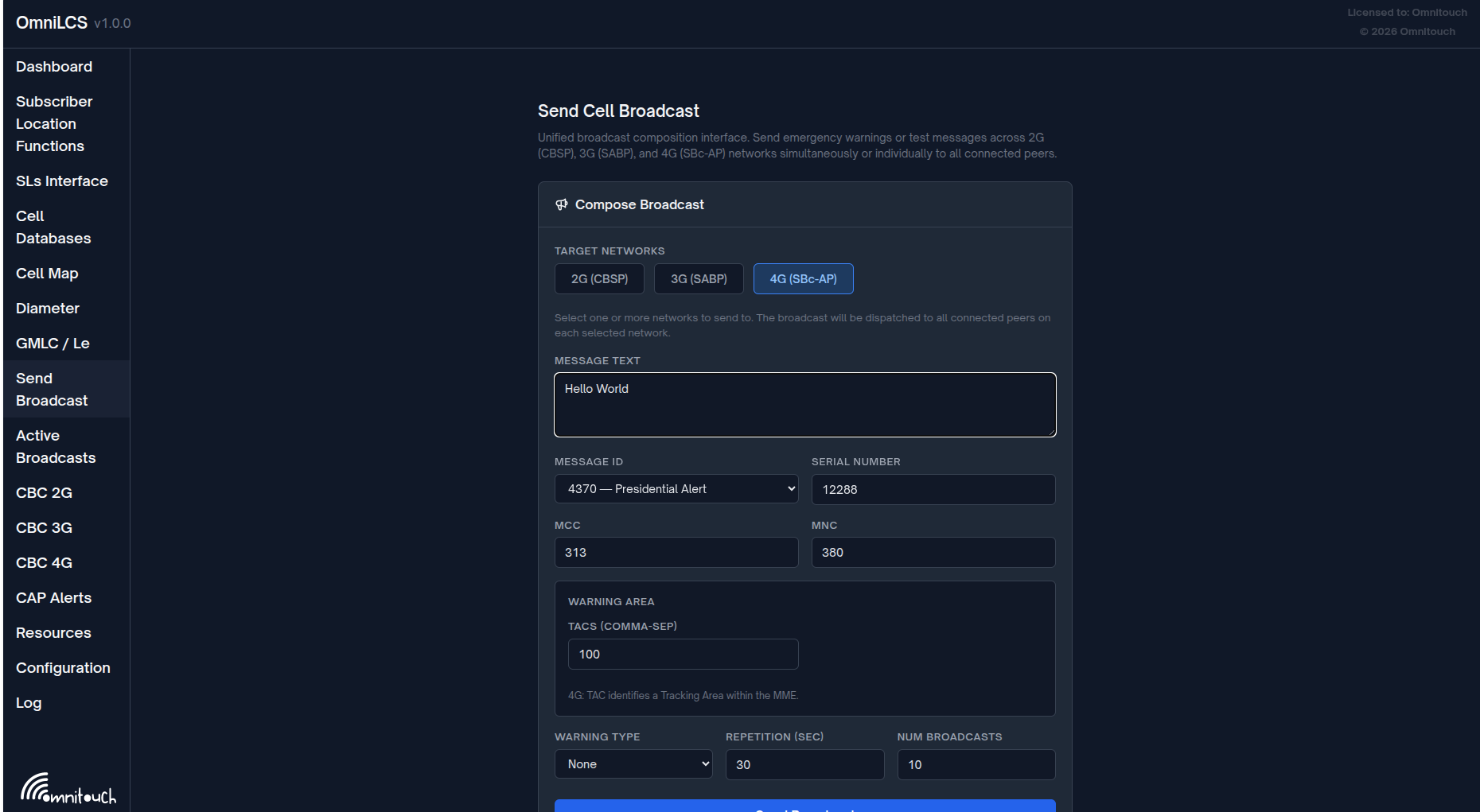
Architecture
2G CBSP Operations
Connection Model
CBSP uses TCP transport per 3GPP TS 48.049. The CBC listens on TCP port 48049 (IANA registered) and BSCs establish inbound connections.
- Each accepted connection spawns a connection handler under a DynamicSupervisor
- Connections are tracked in the
:cbsp_connectionsETS table - Connection state is broadcast via PubSub to the LiveView UI
Keep-Alive
The CBC implements proactive keep-alive:
| Parameter | Default | Description |
|---|---|---|
| Keep-alive interval | 30 seconds | How often the CBC sends KEEP-ALIVE to each peer |
| Keep-alive timeout | 10 seconds | Time to wait for KEEP-ALIVE COMPLETE before marking unhealthy |
The CBC both sends proactive KEEP-ALIVE messages and responds to KEEP-ALIVE messages initiated by BSCs with KEEP-ALIVE COMPLETE.
CBSP Message Types
| Message | Direction | Code | Description |
|---|---|---|---|
| WRITE-REPLACE | CBC -> BSC | 0x01 | Send or update a broadcast message |
| WRITE-REPLACE COMPLETE | BSC -> CBC | 0x02 | Broadcast accepted by BSC |
| WRITE-REPLACE FAILURE | BSC -> CBC | 0x03 | Broadcast rejected by BSC |
| KILL | CBC -> BSC | 0x04 | Stop a broadcast |
| KILL COMPLETE | BSC -> CBC | 0x05 | Broadcast stopped |
| KILL FAILURE | BSC -> CBC | 0x06 | Failed to stop broadcast |
| LOAD-QUERY | CBC -> BSC | 0x07 | Query radio resource loading |
| LOAD-QUERY COMPLETE | BSC -> CBC | 0x08 | Load information returned |
| LOAD-QUERY FAILURE | BSC -> CBC | 0x09 | Load query failed |
| STATUS-QUERY | CBC -> BSC | 0x0A | Query broadcast delivery status |
| STATUS-QUERY COMPLETE | BSC -> CBC | 0x0B | Status information returned |
| STATUS-QUERY FAILURE | BSC -> CBC | 0x0C | Status query failed |
| RESET | CBC -> BSC | 0x10 | Reset broadcast state on BSC |
| RESET COMPLETE | BSC -> CBC | 0x11 | Reset acknowledged |
| RESET FAILURE | BSC -> CBC | 0x12 | Reset failed |
| RESTART | BSC -> CBC | 0x13 | BSC restarted (informational) |
| FAILURE | BSC -> CBC | 0x14 | BSC failure indication |
| ERROR INDICATION | Either | 0x15 | Protocol error |
| KEEP-ALIVE | Either | 0x16 | Connection supervision |
| KEEP-ALIVE COMPLETE | Either | 0x17 | Keep-alive response |
CBSP Message Framing
Every CBSP message on the wire is:
+----------+----------+------+
| Length   | Type     | IEs  |
| (3 bytes)| (1 byte) | ...  |
+----------+----------+------+
The 3-byte length field covers the type byte plus all IEs (excludes the 3 length bytes themselves).
Cell List Formats
The Cell List IE identifies which cells a broadcast targets. Supported formats:
| Discriminator | Value | Format | Description |
|---|---|---|---|
| CGI | 0x00 | MCC+MNC+LAC+CI | Full Cell Global Identity |
| LAC+CI | 0x01 | PLMN+LAC+CI | Location Area Code + Cell Identity |
| CI | 0x02 | CI only | Cell Identity only |
| LAI | 0x04 | MCC+MNC+LAC | Location Area Identity |
| LAC | 0x05 | LAC only | Location Area Code |
| All in BSC | 0x06 | (no cells) | All cells managed by the BSC |
Channel Indicator
| Value | Name | Description |
|---|---|---|
| 0 | Basic CBCH | Primary Cell Broadcast Channel |
| 1 | Extended CBCH | Extended Cell Broadcast Channel (higher capacity) |
3G SABP Operations
The Service Area Broadcast Protocol (SABP) provides the Iu-BC interface between the CBC and RNCs in a 3G UTRAN network, per 3GPP TS 25.419. SABP uses ASN.1 PER aligned encoding over TCP.
Connection Model
SABP uses TCP transport per TS 25.414 §7.1.3.3. The IANA-registered port for SABP is 3452. Per TS 25.419 §5, the CBC initiates connections for normal operations (Write-Replace, Kill, etc.) and the RNC initiates connections only for Failure/Restart Indications. Both sides use destination port 3452 when establishing new connections.
- Each accepted TCP connection spawns a connection handler under the SABP connection DynamicSupervisor
- Connections are tracked in the
:sabp_connectionsETS table - Connection state changes are broadcast via PubSub to the LiveView UI
- TCP keepalive socket option is enabled since SABP has no protocol-level keep-alive mechanism
SABP Message Framing
SABP messages are framed over TCP with a 4-byte big-endian length prefix:
+-------------------+---------------------------+
| Length (4 bytes)   | ASN.1 PER Encoded PDU     |
| big-endian uint32  | ...                       |
+-------------------+---------------------------+
The length field specifies the number of bytes in the ASN.1 PER encoded payload that follows. Multiple messages may arrive in a single TCP segment; the connection handler buffers and reassembles as needed.
SABP Procedures
| Procedure | Code | Class | Direction | Description |
|---|---|---|---|---|
| Write-Replace | 0 | Class 1 | CBC -> RNC | Send or update a broadcast message |
| Kill | 1 | Class 1 | CBC -> RNC | Stop an active broadcast |
| Load-Status-Enquiry | 2 | Class 1 | CBC -> RNC | Query radio resource loading |
| Message-Status-Query | 3 | Class 1 | CBC -> RNC | Query broadcast delivery status |
| Reset | 4 | Class 1 | CBC -> RNC | Reset broadcast state on RNC |
| Restart-Indication | 5 | Class 2 | RNC -> CBC | RNC restarted, re-send active broadcasts |
| Failure-Indication | 6 | Class 2 | RNC -> CBC | RNC failure indication |
| Error-Indication | 7 | Class 2 | Either | Report a protocol error |
SABP Information Elements
The SABP protocol uses ASN.1-defined Information Elements (IEs). Key IEs used in Write-Replace:
| IE | ID | Criticality | Type | Description |
|---|---|---|---|---|
| Broadcast-Message-Content | 0 | Reject | Binary | Encoded CBS message content |
| Category | 1 | Ignore | Enum | Message priority (high, normal, background, default) |
| Cause | 2 | Ignore | Integer | Cause value for failure/error indications |
| Data-Coding-Scheme | 4 | Ignore | 8-bit | How message content is encoded (e.g., 0x0F for GSM 7-bit) |
| Message-Identifier | 6 | Reject | 16-bit | CB message identifier |
| New-Serial-Number | 7 | Reject | 16-bit | Serial number for the new/updated broadcast |
| Number-of-Broadcasts-Requested | 9 | Reject | Integer | Total broadcast count (0..65535) |
| Old-Serial-Number | 10 | Ignore | 16-bit | Serial number of message being replaced (optional) |
| Repetition-Period | 13 | Reject | Integer | Seconds between repetitions (1..4096) |
| Service-Areas-List | 15 | Reject | List | Target service areas (list of SAIs) |
Service Area Identifier (SAI)
SABP targets broadcasts to specific Service Areas identified by SAIs. Each SAI consists of:
| Field | Size | Description |
|---|---|---|
| PLMN Identity | 3 bytes | BCD-encoded MCC+MNC per 3GPP TS 24.008 |
| LAC | 2 bytes | Location Area Code |
| SAC | 2 bytes | Service Area Code |
Broadcast Category
The optional Category IE sets the priority of a broadcast message:
| Category | Description |
|---|---|
| high-priority | Highest priority, pre-empts other broadcasts |
| normal-priority | Standard priority |
| background-priority | Low priority, does not pre-empt |
| default-priority | Default when no category is specified |
Restart-Indication and Failure-Indication Handling
When the CBC receives a Restart-Indication from an RNC, the RNC has restarted and lost its broadcast state. The CBC should re-send all active broadcasts to that RNC.
When the CBC receives a Failure-Indication, the RNC is reporting that certain service areas have lost broadcast capability. This is logged and emitted as a telemetry event.
4G SBC-AP Operations
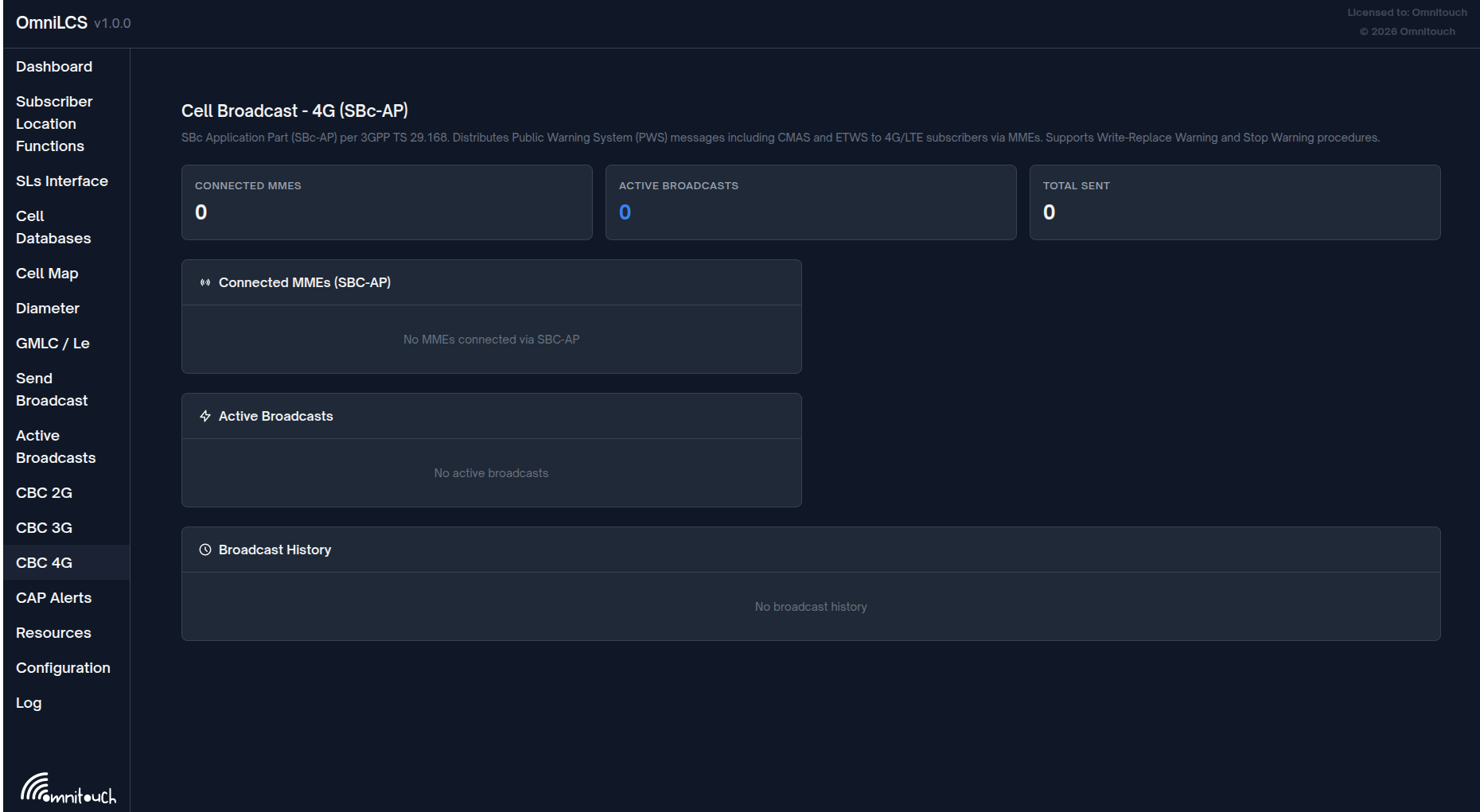
Connection Model
Per 3GPP TS 29.168 Section 4.3, the CBC initiates SCTP associations to each MME. The MME listens on port 29168 (IANA registered). The SCTP Payload Protocol Identifier (PPID) for SBC-AP is 24.
The transport implements automatic reconnection with exponential backoff:
| Parameter | Value | Description |
|---|---|---|
| Initial reconnect delay | 5 seconds | First retry delay after connection failure |
| Maximum reconnect delay | 60 seconds | Maximum backoff ceiling |
| SCTP heartbeat interval | 10 seconds | Peer address heartbeat |
| SCTP path max retransmissions | 7 | Before declaring path failure |
| SCTP RTO max | 30 seconds | Maximum retransmission timeout |
| SCTP RTO min | 1 second | Minimum retransmission timeout |
SBC-AP Procedures
| Procedure | Code | Class | Direction | Description |
|---|---|---|---|---|
| Write-Replace-Warning | 0 | Class 1 | CBC -> MME | Send or update a warning message |
| Stop-Warning | 1 | Class 1 | CBC -> MME | Stop an active warning |
| Error-Indication | 2 | Class 2 | Either | Report a protocol error |
| PWS-Restart-Indication | 3 | Class 2 | MME -> CBC | MME restarted, re-send active warnings |
| PWS-Failure-Indication | 4 | Class 2 | MME -> CBC | eNB failure, cells lost broadcast capability |
Write-Replace-Warning-Request IEs
| IE | ID | Criticality | Type | Description |
|---|---|---|---|---|
| Message-Identifier | 5 | Reject | 16-bit | CB message identifier (e.g., 0x1112 for CMAS) |
| Serial-Number | 11 | Reject | 16-bit | Serial number with geo scope, msg code, update number |
| List-of-TAIs | 14 | Reject | List | Tracking area identities for the broadcast |
| Warning-Area-List | 15 | Ignore | Choice | Target area (TAI list, cell list, or emergency area) |
| Repetition-Period | 10 | Reject | Integer | Seconds between repetitions (0..4096) |
| Number-of-Broadcasts-Requested | 7 | Reject | Integer | Total broadcast count (0..65535) |
| Warning-Type | 18 | Ignore | 2 bytes | ETWS warning type + activation flags |
| Data-Coding-Scheme | 3 | Ignore | 8-bit | How message content is encoded |
| Warning-Message-Content | 16 | Ignore | Binary | Encoded CBS pages |
| Omc-Id | 19 | Ignore | Binary | Operations centre identifier |
| Concurrent-Warning-Message-Indicator | 20 | Reject | Boolean | Allow concurrent warnings |
Stop-Warning-Request IEs
| IE | ID | Criticality | Description |
|---|---|---|---|
| Message-Identifier | 5 | Reject | CB message identifier to stop |
| Serial-Number | 11 | Reject | Serial number of the broadcast to stop |
| List-of-TAIs | 14 | Reject | (Optional) Limit stop to specific TAIs |
| Warning-Area-List | 15 | Ignore | (Optional) Limit stop to specific areas |
PWS-Restart-Indication Handling
When the CBC receives a PWS-Restart-Indication from an MME, it re-sends all active broadcasts (those in :sent or :acknowledged status) to that MME. This ensures broadcast continuity after MME restarts.
PWS-Failure-Indication Handling
When the CBC receives a PWS-Failure-Indication, it marks affected broadcasts with a :pws_failure response for the reporting MME association. This is logged as a warning.
Message Formatting
GSM 7-bit Encoding
The default encoding for CBS messages. Each CBS page holds up to 93 septets packed into 82 bytes.
The GSM 7-bit default alphabet maps standard Latin characters plus Greek letters and special symbols. Characters not in the basic alphabet use the extension table (escape sequence 0x1B + extension code), consuming two septets.
The Warning-Message-Content binary structure:
+----------+-------------------------------------------+
| Num Pages| Page 1 (82 bytes packed + 1 byte length) |
| (1 byte) | Page 2 ...                                |
+----------+-------------------------------------------+
UCS-2 Encoding
For non-Latin scripts (CJK, Arabic, Thai, etc.). Each CBS page holds up to 40 UCS-2 characters (80 bytes of UTF-16BE data), padded to 82 bytes.
Data Coding Scheme (DCS)
| Encoding | DCS Value | Description |
|---|---|---|
| GSM 7-bit | 0x0F | GSM 7-bit default alphabet, language unspecified |
| UCS-2 | 0x48 | UCS-2 (UTF-16BE), language unspecified |
The DCS can be set explicitly per broadcast or is auto-derived from the encoding parameter.
Serial Number Structure
Per 3GPP TS 23.041 Section 9.4.1.2.1, the 16-bit serial number has internal structure:
+----+------------+--------+
| GS | Msg Code   | Update |
| 2b | 10 bits    | 4 bits |
+----+------------+--------+
| Field | Bits | Description |
|---|---|---|
| Geographical Scope (GS) | 15-14 | 0 = Cell-wide immediate, 1 = PLMN-wide, 2 = LA/TA-wide, 3 = Cell-wide |
| Message Code | 13-4 | Identifies the broadcast within its scope (0..1023) |
| Update Number | 3-0 | Incremented for message updates (0..15) |
The serial number is constructed from these components.
Warning Types (ETWS)
The Warning-Type IE is 2 bytes per 3GPP TS 23.041 Section 9.3.24:
| Warning Type | Octet 1 Value | Description |
|---|---|---|
| Earthquake | 0x00 | Earthquake warning |
| Tsunami | 0x01 | Tsunami warning |
| Earthquake + Tsunami | 0x02 | Combined earthquake and tsunami |
| Test | 0x03 | Test warning |
| Other | 0x04 | Other emergency |
Octet 2 activation flags (default 0xC0):
| Bit | Value | Description |
|---|---|---|
| Bit 8 | 0x80 | Emergency User Alert (activate alert tone/vibration) |
| Bit 7 | 0x40 | Popup (automatically display message on screen) |
Both bits are set by default (0xC0) to ensure maximum visibility.
Broadcast State Management
State Lifecycle
Persistence
Active broadcasts for 2G, 3G, and 4G are persisted to priv/active_broadcasts.json as JSON. On startup, the Engine reloads this file to restore broadcast state. This allows the CBC to re-send active warnings after application restart. The persistence file stores three separate broadcast maps: active_broadcasts_4g, active_broadcasts_3g, and active_broadcasts_2g3g.
Response Tracking
For 4G broadcasts, each send_broadcast_4g starts a 30-second response timeout timer. Responses from MMEs are correlated by Message-Identifier and Serial-Number. The timer is cancelled when all expected MME peers have responded. Timed-out peers are logged with a :timeout cause.
Active Broadcasts View
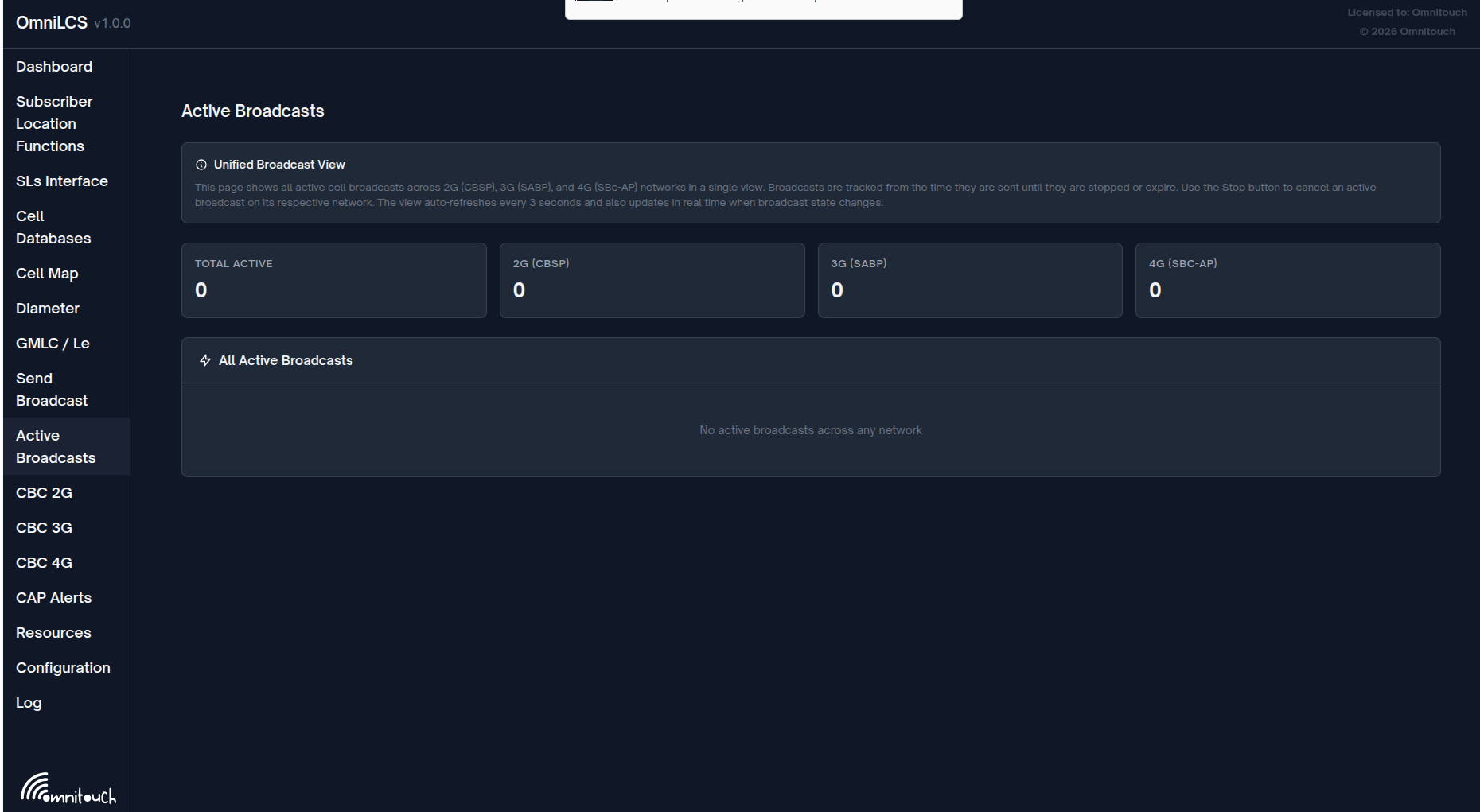
The Active Broadcasts page provides a unified view of all in-flight broadcasts across 2G, 3G, and 4G networks.
Broadcast History
The Engine maintains a rolling history of the last 100 4G broadcasts for the LiveView UI and API queries.
Troubleshooting
No MMEs Connected (SBC-AP)
- Verify
mme_peersconfiguration contains correct IP addresses and ports - Check that the
local_ipis reachable from the MME network - Look for SCTP connection errors in the log:
SBC-AP: Failed to connect to MME - Verify SCTP is not blocked by firewalls (protocol 132)
- Confirm MME is listening on port 29168
No BSCs Connected (CBSP)
- Verify
listen_ipandlisten_portconfiguration under:cbsp - Check that TCP port 48049 is not blocked by firewalls
- Look for accept errors:
CBSP accept failed - Confirm BSC is configured with the CBC IP address and port
No RNCs Connected (SABP)
- Verify
listen_ipandlisten_portconfiguration under:sabp - Check that TCP port 3452 is not blocked by firewalls
- Look for accept errors:
SABP accept failed - Confirm RNC is configured with the CBC IP address and port
- Check logs for
SABP connection closed by peerorSABP TCP errormessages
Broadcast Not Delivered
- Check the active broadcasts table for response status
- Look for WRITE-REPLACE FAILURE or KILL FAILURE messages in the CBSP/SABP message log
- Verify cell list format matches what the BSC/RNC/MME expects
- For 4G, check that TAC values are valid for the target MME
- For 3G, check that Service Area Identifiers (SAIs) are valid for the target RNC
- Check the broadcast history for timeout entries
Encoding Issues
- For non-Latin text, ensure
:ucs2encoding is selected - Verify the DCS matches the encoding (0x0F for GSM 7-bit, 0x48 for UCS-2)
- GSM 7-bit can only represent the GSM default alphabet; unsupported characters are replaced with
?
3GPP References
| Specification | Title |
|---|---|
| TS 25.419 | UTRAN Iu-BC interface: Service Area Broadcast Protocol (SABP) |
| TS 29.168 | Cell Broadcast Centre interfaces with the Evolved Packet Core (SBC-AP) |
| TS 48.049 | Cell Broadcast Centre Protocol (CBSP) |
| TS 23.041 | Technical realization of Cell Broadcast Service (CBS) |
| TS 23.038 | Alphabets and language-specific information (DCS, GSM 7-bit) |
| TS 24.008 | Mobile radio interface layer 3 specification (PLMN identity encoding) |