OmniSS7 - User Guide
OmniSS7 by Omnitouch Network Services is a comprehensive, general-purpose SS7 signaling stack that provides flexible network element functionality.
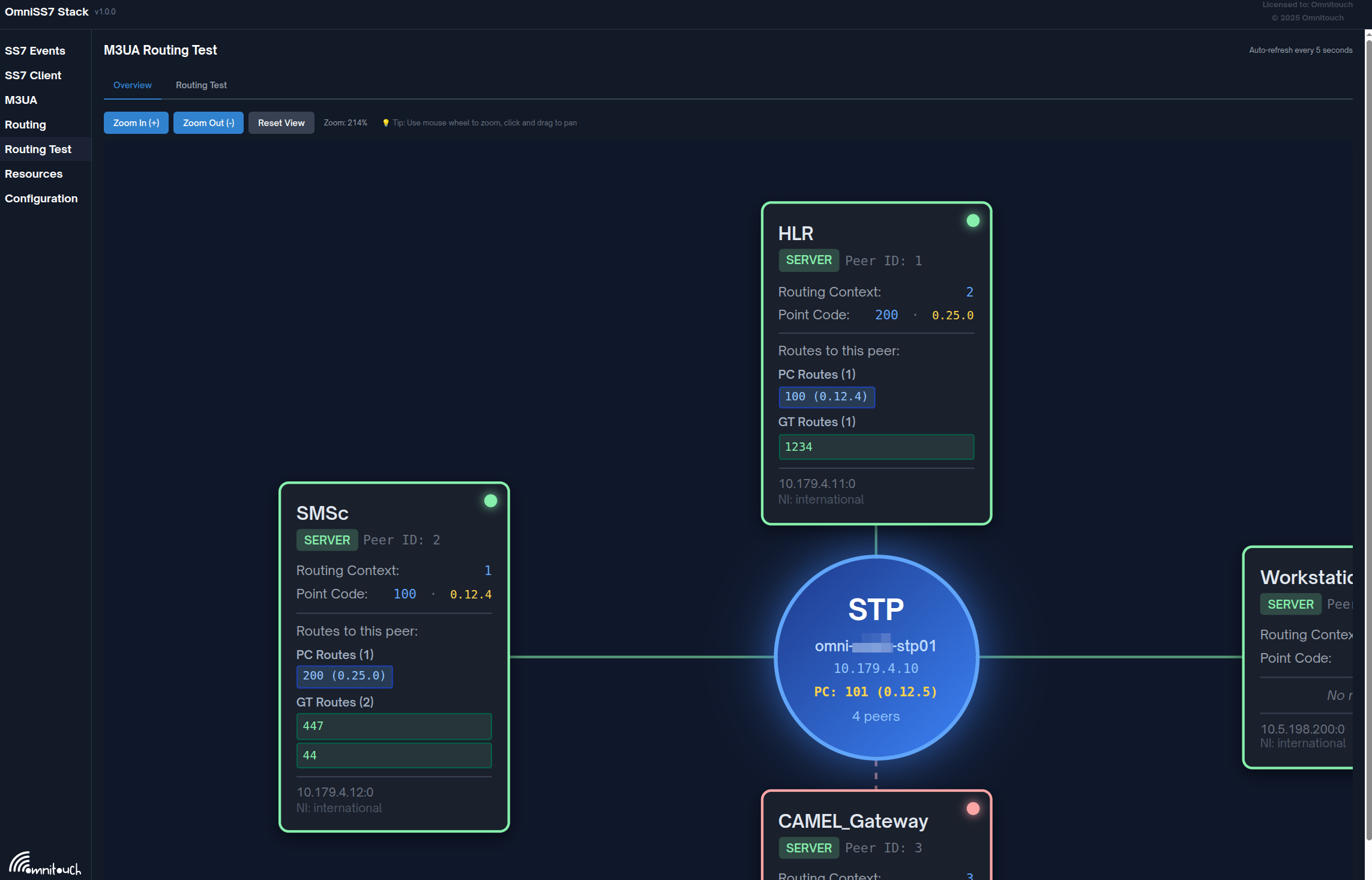
Documentation Overview
This documentation is organized by network element role. Choose the guide that matches your deployment:
📚 Configuration Guides
-
STP Guide - Signal Transfer Point Configuration
- Route SS7 traffic between network peers
- Point Code and Global Title routing
- Load balancing and topology hiding
- Use this if you're routing SS7 traffic between networks
-
MAP Client Guide - MAP Client Configuration
- Connect as M3UA client to send MAP requests
- HLR queries, authentication, routing info
- Generic MAP protocol support
- Use this if you're sending MAP requests to network elements
-
SMS Center Guide - SMS Center (SMSc) Configuration
- SMS message routing and delivery
- Database-backed message queuing
- Auto-flush and delivery reports
- Use this if you're operating an SMS Center
-
HLR Guide - Home Location Register Configuration
- Subscriber database management
- Authentication vector generation
- Location updates and routing information
- Use this if you're operating an HLR/HSS
-
CAMEL Gateway Guide - CAMEL Gateway Configuration
- Intelligent network services (CAP/CAMEL)
- Real-time call control and charging
- CGrateS integration for billing
- Interactive request builder and session monitoring
- Use this if you're providing IN services or real-time charging
-
USSD Gateway Guide - USSD Gateway Configuration
- Bridge SS7/MAP USSD to HTTP/JSON callbacks
- Multi-turn interactive USSD menus
- Short code routing to different callback URLs
- Network-originated USSD push via REST API
- Use this if you're building USSD applications (balance checks, top-ups, etc.)
🔧 Common Features
- Common Features Guide - Shared Components
- Web UI overview and configuration
- API documentation
- Monitoring and metrics (Prometheus)
- Best practices and troubleshooting
📖 Reference Documentation
- Appendix - Technical Reference
- SS7 protocol specifications
- MAP operation codes
- TCAP transaction flows
- Character encodings and formats
Quick Start
1. System Overview
OmniSS7 can operate in different modes depending on your network requirements:
3. Configuration
OmniSS7 selects its role from a set of mode flags in config/config.exs. The flags compose, so a single instance can act as several roles at once (for example, MAP Client plus SMSc).
Note:
config/runtime.exsin this repository is a short test stub. Production servers have their ownruntime.exsdeployed separately. Editconfig/config.exs(and the environment-specific file it imports) to change the default configuration.
To select a role:
- Set the relevant mode flags in
config/config.exs - Configure the M3UA connection (
map_client_m3uaorcap_client_m3ua) and any backend API URLs - Restart the application
→ See the mode-specific guides below for complete configuration instructions
STP Mode — route SCCP/M3UA traffic between peers:
config :omniss7,
  sctp_handler: %{enabled: true, local_ip: {0, 0, 0, 0}, local_port: 2905, point_code: 100},
  enable_gt_routing: true,
  m3ua_peers: [...],
  m3ua_routes: [...],
  m3ua_gt_routes: [...]
HLR Mode:
config :omniss7,
  hlr_mode_enabled: true,
  map_client_enabled: true,
  hlr_api_base_url: "https://hlr-backend:8443",
  map_client_m3ua: %{...}
SMSc Mode:
config :omniss7,
  map_client_enabled: true,
  smsc_mode_enabled: true,
  smsc_api_base_url: "https://smsc-backend:8443",
  auto_flush_enabled: true,
  map_client_m3ua: %{...}
CAMEL Gateway Mode:
config :omniss7,
  cap_client_enabled: true,
  camelgw_mode_enabled: true,
  cgrates_enabled: true,
  cgrates_url: "http://localhost:2080/jsonrpc",
  cgrates_tenant: "cgrates.org",
  cap_client_m3ua: %{...}
See the Configuration Reference for every parameter, including the USSD Gateway (ussd_gateway_enabled).
4. Access Web UI
The Web UI is served over HTTPS on port 8087 — for example https://localhost:8087/ (or your configured host). The endpoint enforces TLS, so plain http:// is redirected.
System Architecture
Feature Matrix
| Feature | STP Mode | MAP Client | SMSc Mode | HLR Mode | CAMEL GW |
|---|---|---|---|---|---|
| Point Code Routing | ✅ | ❌ | ❌ | ❌ | ❌ |
| Global Title Routing | ✅ | ❌ | ❌ | ❌ | ❌ |
| SSN Rewriting | ✅ | ❌ | ❌ | ❌ | ❌ |
| Multi-Peer Support | ✅ | ✅ | ✅ | ✅ | ✅ |
| MAP Requests (Send) | ❌ | ✅ | ✅ | ✅ | ❌ |
| MAP Responses (Receive) | ❌ | ✅ | ✅ | ✅ | ❌ |
| SMS Queue Management | ❌ | ❌ | ✅ | ❌ | ❌ |
| Auto-Flush SMS | ❌ | ❌ | ✅ | ❌ | ❌ |
| Subscriber Database | ❌ | ❌ | ❌ | ✅ | ❌ |
| Authentication Vectors | ❌ | ❌ | ❌ | ✅ | ❌ |
| Location Updates | ❌ | ❌ | ❌ | ✅ | ❌ |
| CAP/CAMEL Support | ❌ | ❌ | ❌ | ❌ | ✅ |
| Real-time Charging | ❌ | ❌ | ❌ | ❌ | ✅ |
| Call Control (IN Services) | ❌ | ❌ | ❌ | ❌ | ✅ |
| Web UI | ✅ | ✅ | ✅ | ✅ | ✅ |
| REST API | ✅ | ✅ | ✅ | ✅ | ✅ |
| Prometheus Metrics | ✅ | ✅ | ✅ | ✅ | ✅ |
Common Operations
OmniSS7 listens on several ports, each serving a different surface:
| Port | Protocol | Served by | Purpose |
|---|---|---|---|
8087 | HTTPS | ControlPanel (Phoenix) | Web UI dashboard (TLS enforced) |
8445 | HTTPS | api_ex | JSON status API (/api/status, /api/m3ua-status, /api/routing, …) |
8080 | HTTP | APIhandler (Plug.Cowboy) | MAP operation API (/api/*), Swagger UI (/swagger), OpenAPI spec (/swagger.json), Prometheus metrics (/metrics) |
2905 | SCTP | M3UA/M2PA | SS7 signaling transport |
Web UI Access
- Web UI:
https://localhost:8087/(or configured host) - Swagger UI:
http://localhost:8080/swagger - OpenAPI spec:
http://localhost:8080/swagger.json - Metrics:
http://localhost:8080/metrics
Monitoring
# View Prometheus metrics
curl http://localhost:8080/metrics

# Check M3UA peer status (TLS, self-signed cert)
curl -k https://localhost:8445/api/m3ua-status

# Service status
curl -k https://localhost:8445/api/status
Logs
Logs are emitted as structured JSON (one object per line) for ingestion by Loki/Alloy, via OmniLogger.JsonFormatter. Set the log level in config/config.exs:
config :logger,
  level: :debug  # Options: :debug, :info, :warning, :error
Key Capabilities
- Full MAP Protocol Support - MAP Phase 2/3 operations
- CAP/CAMEL Protocol Support - CAP v1/v2/v3/v4 for intelligent network services
- M3UA/SCTP Signaling - IP-based SS7 transport
- Real-time Charging - CGrateS integration for prepaid/postpaid billing
- SMS Delivery - HTTP/JSON backed message queue with auto-flush
- Interactive Request Builder - Web UI for CAMEL/CAP testing
- Session Monitoring - Real-time CAMEL call session tracking
- Interactive API Docs - Swagger UI for testing
- Prometheus Metrics - Complete observability
- Multi-role Configuration - STP, MAP Client, SMSc, HLR, CAMEL Gateway, USSD Gateway
Protocol Stack Overview
Use Case Examples
Network Gateway (STP)
Route SS7 traffic between different mobile networks
- Connect operator networks
- International SS7 gateway
- Load balancing across HLRs
- Global Title Translation
- SCCP NAT (Smart Global Title reuse)
- → STP Guide
SMS Center (SMSc)
Deliver SMS messages to mobile subscribers
- MT-SMS delivery
- MO-SMS origination
- SMS Home Routing
- IMSI Hiding
- SMS Firewall
- Message queue management
- Delivery reports
- Integrated into OmniMessage to handle all MAP SMS
- → SMS Center Guide
MAP Client
Interact with any network elements over MAP using a simple RESTful API
- PRN / SRI / ATI / etc
- Build your own SS7/MAP applications using RESTful APIs
- USSD Gateways
- Authentication vector requests
- IMSI/MSISDN lookups
- Routing information queries
- → MAP Client Guide
Subscriber Database (HLR)
Manage subscriber data and authentication
- Location updates
- Authentication generation
- Routing information provisioning
- Integrates fully into OmniHSS
- → HLR Guide
Intelligent Network Platform (CAMEL Gateway)
Real-time call control and charging for telecom operators
- Prepaid/postpaid call charging
- Call control (connect, release, routing)
- Session management and CDR generation
- Interactive request builder for testing
- → CAMEL Gateway Guide
Support and Resources
Documentation
Core Configuration Guides:
- STP Configuration Guide - Signal Transfer Point routing
- MAP Client Configuration Guide - MAP protocol client
- SMS Center Configuration Guide - SMS routing and delivery
- HLR Configuration Guide - Subscriber database
- CAMEL Gateway Configuration Guide - Intelligent network & charging
Integration & Reference:
- CAMEL Request Builder Guide - Interactive testing tool
- Common Features Guide - Shared components & Web UI
- Technical Reference - Protocol specifications